Brazil is an economic powerhouse. Still, its global influence wanes as economic trends elsewhere mean its total share of the world economy is declining. Brazilian President Lula da Silva seems intent on shifting that sentiment, at least in diplomatic theater. An obstacle is that there is not enough room for Brazil also to be stage center. Consider this point: Among developing nations, China, Russia, and Turkey all have more diplomatic posts abroad than Brazil.
Lula’s attempts to inject a multi-polar view into the Ukraine-Russia War have been rebuffed by Western allies. His comment “[Zelenskyy] is as responsible as Putin for the war” seemed innocent enough when he was a presidential candidate, but amplifying that view as the President of Brazil proves to be another matter. Zelenskyy was unwilling to meet with Lula at last month’s G7 meeting in Japan. Since these affairs are highly scripted, Washington and Brussels most likely had a role in structuring that decision.
Regional leadership offers more comfort and prominence because there is a vast amount of room to maneuver. Among key economies, Argentina is dogged by economic-policy missteps; Venezuela harbors further social unrest with a federal election next year; Chile and Colombia wrestle with faltering political leadership. And the United States, which tends to be more tactical than strategic in South America, is fully preoccupied with Russia and China. Washington’s Latin American policy may begin and end at the Mexican border. Americans are not well-known for geographic precision.
For Lula, advocating for a regional currency is fertile ground. Brazil certainly offers the economic heft to make it happen, at least theoretically. The problem here is that the benefits seem academic in a region where nations deeply cherish their sovereignty. The primary impetus for this policy initiative may be an attempt to circumvent US sanctions on Russia by downplaying the role of the US dollar in the Brazilian economy. Organic momentum in favor of the sur—a working name for the proposed store of value—seems limited in scope and short in duration.
Why did Lula raise the idea of a regional currency at the recent summit of Latin American presidents in Brasilia? He asserted, “I want to deepen our South American identity… through a more efficient payment system and the creation of a common unit of reference for trade.” The goal is noble, but achieving that outcome is likely to come at enormous fiscal, if not monetary costs. Brazil is realistically unable to sustain that focus over the long term. We attribute Lula’s enthusiasm to the role of anti-imperialist messaging, offering proven political clout.
There may be some merit to the idea, especially as it may relate to a Venezuela-Brazil currency union. But that too seems academic. Smoothing remittance flows for economic refugees is indeed admirable. We question whether the volume of those refugees is sufficient to sway public opinion across the full breadth of Brazilian voters. In a country where the population reaches 220 million, Venezuelans, both refugees and immigrants, represent less than one million people. In recent years, most Venezuelans fleeing the Maduro regime have gone to Colombia, Peru, Chile, or Ecuador.
For international context, we look afar to the Gulf nations where the notion of a regional currency across the GCC has been in play for decades. The idea tends to surface at low points in the economic cycle and then fades as the oil price builds momentum. Most recently, there was a flourish of interest in a common unit in 2021, amid pandemic uncertainty. Elsewhere, the euro is not a relevant point of reference, given that the EU is an advanced economy with near-limitless resources to support its currency union.
In Brazil, the sur is topical with Lula and his advisors. Market practitioners seem less interested. Both Brazilian stocks and the Brazilian real have seen notable rallies this year, while the underlying economy perks along nicely. The nation saw a record trade surplus in May, in part because of surging demand for key commodities like soybeans, oil, and sugar. These exports are priced in dollars. ■
Our Vantage Point: Lula struggles for a win on the international stage to project his legacy beyond his presidential term. Inserting himself into Ukraine-Russia relations seems futile. Raising the promise of a currency union in South America offers an agenda that transcends domestic economic issues.
Learn more at Americas Quarterly
© 2023 Cranganore Inc. All rights reserved.
Unauthorized use and/or duplication of any material on this site without written permission is prohibited.
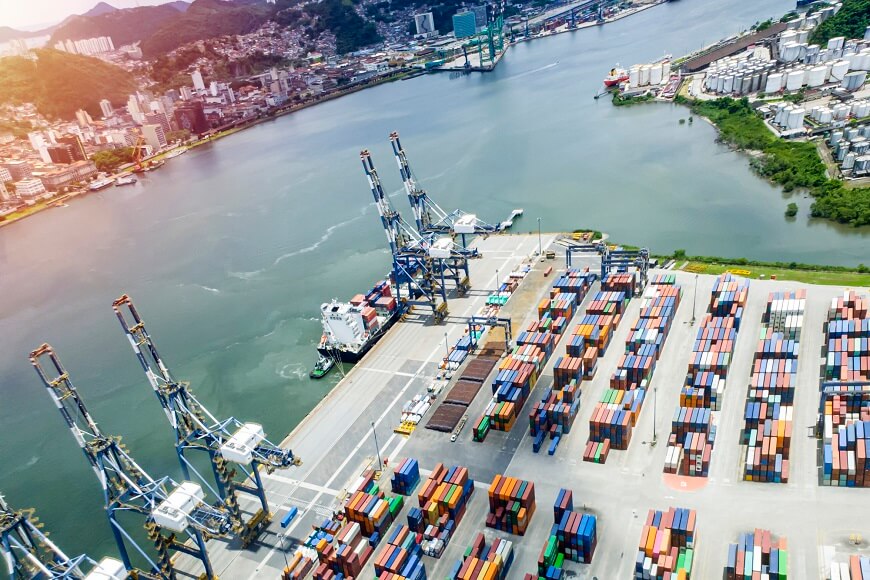
Image: In Brazil, the Port of Santos may be responsible for as much as one-third of foreign trade. Credit: Wsfurlan at iStock by Getty Images.